
.a.course.in.phonetics
 A Course in Phonetics, 7th Edition. Peter Ladefoged and Keith Johnson. (2015)
This is a revised and up-dated version of Peter Ladefoged's classic phonetics textbook. The major changes that I introduced in this new edition were to reframe the discussion of phonetic theory and the relationship between phonetics and phonology, and to update and clarify the presentation of the acoustic theory of speech production. I also added new exercises in some chapters, and added new data on speech production in a few places.
There is an extensive web page to accompany the book - which contains all of the materials that used to be provided on a CD with the book, and more.
.acoustic.phonetics
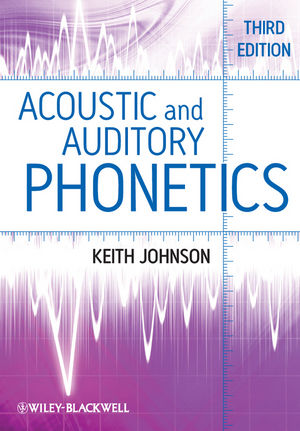 Acoustic and Auditory Phonetics, 3rd edition. Keith Johnson (2011)
This book started as a set of handouts for an acoustic phonetics course at the 1993 Linguistics Institute. I expanded the handouts while I was at the University of Alabama, Birmingham (mainly at my table at Cosmos' Pizza) and then again in response to feedback from students at OSU and teachers who had used the book at several other universities (thanks especially to Janet Pierrehumbert and John Ohala). The book presents the acoustic theory of speech production and example spectrograms and auditory analyses for all of the major classes of speech sounds. I enjoyed writing it and am gratified by the good reception that it is enjoying. Thanks also to all of you who gave me feedback on how to improve the book in the 2nd edition.
.quantitative.methods
 Quantitative Methods in Linguistics. Keith Johnson (2008)
My aim with this book was to demonstrate the use of quantitative methods in several areas of linguistic research with good core theoretical background and then a few simple examples and implementational detail so that researchers could learn something valuable about the quantitative approach even if this has not been their usual strategy as linguists. The book assumes no prior background in statistics and provides guidance from the ground up - from installing a statistical analysis package to producing publication quality analyses and graphics.
You can download the example data sets used in "Quantitative Methods" directly from the publisher's web page..phonetics.and.phonology
 The Role of Speech Perception in Phonology. Edited by
Elizabeth V. Hume Keith Johnson. (2001)
The Role of Speech Perception in Phonology. Edited by
Elizabeth V. Hume Keith Johnson. (2001)
Do human auditory perceptual abilities shape language sound structures? If so, what aspects of phonology may be driven by perception, and how should perceptually driven processes be captured in linguistic theory? These and similar questions have come to the forefront of linguistic research in the last decade because the technology used in speech perception research has become much more widely available and portable, and because developments in constraint-based theories of phonology have made it possible to incorporate 'perceptual constraints' in linguistic grammars. This book is a collection of authoritative articles on the role of speech perception in phonology by leading phonologists, phoneticians, and cognitive psychologists. This book is about how hearing abilities shape language sound systems. Patterns of perceptual salience influence language sound patterns. This seemingly simple perspective poses a challenge for traditional theories of language sound systems that have been based largely on facts about speech pronunciation abilities, to the exclusion of hearing.
.talker.variability
 Talker Variability in Speech Processing. Edited by Keith
Johnson & John Mullennix. (1987)
Talker Variability in Speech Processing. Edited by Keith
Johnson & John Mullennix. (1987)
This book is now out of print, rare, and hard to find. If you see a used one for sale definitely snap it up.
This is a volume of papers that I edited with John Mullennix. The point of the book is that when you consider the range of variation in spoken language exhibited by different talkers, then your theory of speech perception (or your strategy in automatic speech recognition) has to take a different form than it would otherwise. Mullennix and I argue in the book's introduction that the theoretical implications of talker variability are that the mental representations of speech categories must be significantly richer than most theories of speech perception have previously assumed. Of course, some alternative viewpoints are expressed in the book and that's what makes it an interesting read.